|
Orhan
PAMUK Is A Hit in Chicago
by Sel Erder YACKLEY, Midwest
Correspondent
Orhan Pamuk addressed more than 150
people at the University of Chicago recently.
The standing-room only crowd heard him read a
few paragraphs from his book My Name Is Red and
then talk about his experience writing this, his sixth
novel which has been translated into 20 different languages.
Orhan
Pamuk is at the University of Chicago. Pamuk presented
his book,
My Name is Red, which published in the
US in September 2001.
Pamuk
was invited to Chicago by the Center for Middle Eastern
Studies at the University which used this opportunity
as a symposium of sorts. Moderator and organizer was Prof. Hakan
Ozoglu, Ayasli Turkish Language Lecturer.
Considered one of the most prominent European novelists
whose works have been translated into more than twenty
languages, Pamuk was born in Istanbul, June 7,1952.
He spent all his life in this city, except for
three years he lived in New York.
Pamuk told the audience he came from a family of engineers,
but did not want to become one. "I loved to paint,
starting at an early age,"he said. "My family
said I did not have to become an engineer but should
attend the Architectural Department of Istanbul Technical
University for three years," he explained. He finally gave in to his creative tendencies
and finished The Institute of Journalism. He started writing regularly at age 22 in 1974. "I usually write 10 hours a day,"
he explained.
His books include The White Castle, The Black Book,
The New Life---all
internationally acclaimed.
The latest "Kar" was recently published
in Turkey.
Moderator
(from left) Prof. Hakan Ozoglu, Prof. Cornell Fleischer,
Prof.
Faik Mustafa and Stephen Kinzer.
Following Pamuk's talk three panelists critiqued the
book and spoke about their impressions and conclusions.
They were: Prof. Faik Mustafa, who teaches Arabic,
Prof.Cornell Fleischer, Kanuni Suleyman Professor of
Ottoman and Modern Turkish Studies who is, a friend
of Pamuk and another friend, Stephen Kinzer ,of the
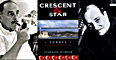
New York Times who authored the book Crescent and
Star: Turkey
Between Two Worlds in 2001. All three congratulated
Pamuk for the excellence in his writing and research,
and the creative manner in which he brought to life
Ottoman miniaturists'--their characters, passions, artistic
talents and short falls.
The setting of My Name is Red is Istanbul in
year 1591. The Ottoman Sultan Murad III secretly commissions an illustrated
book, which will celebrate his life and wants this book
to be ready for the "Millennial Commemoration of
Hegira" (Emigration of prophet Muhammad from Mecca
to Medina). At
the same time, the Sultan intends to gift this book
with a portrait of himself to the Venetian Dodge---demonstrating
his achievements with western style paintings.
Even though in Islam, figurative painting is
forbidden, the Sultan's plan is to impress the Venetian
Court and show them that Ottoman artists can also paint
in their style, complete with perspective and three
dimensions on a two dimensional canvas.
Sel
Erder YACKLEY (right) with Semra Prescott (left) members
of International Women
Associates in Chicago)
Pamuk's story is multi-faceted, working on many different
aspects of life, belief and traditions of sixteenth
century Ottoman society. It is a superbly narrated historical murder mystery, a book
of ideas, and a passionate love story--written through
the mouths of 12 different narrators.
As pointed out by all the panelists, My
Name Is Red's a timely book especially since the
Islamic East and the Christian West are at odds with
each other.
The two-hour discussion concluded with questions from
the audience, which included Consul General of Turkey--Hon.
Yavuz Aktas and Mrs. Fatos Aktos, a dozen professors,
members of the International Women's Associates, writers'
groups, authors and scores of graduate students. A buffet dinner followed the presentation.
Orhan Pamuk's stops in the U.S.A. included Iowa,
Chicago, New York and Washington D.C.
Sel Erder Yackley
Say it with Sel Enterprises
E-mail to: seliko@earthlink.net
This article originally written for the Turkish Times.
Special Thanks to Ms. Yackley for sharing her article
also with us.
|